
LowerDotcomLogo.jpg (2555 bytes)

EastDivCombo.jpg (2262 bytes) WestDivCombo.jpg (2267 bytes)
.

Guest Essays
on the
American Football League

         American Football league fans and historians have a wealth of information, memories and opinions about the league that was the genesis of modern professional football.   While some of these are posted at the AFL Guestbook, fans have often indicated they would like a forum where more detail could be expressed.   This page will periodically display "essays" on the life and times of the American Football League.

.

The Hundred-Yard Club
Essay by TJ Troup

May 1, 2005

During the decade of the 1960's, the American Football League was known for explosive offense, and there sure was plenty of offense to watch; both running and passing.  But how successful were teams defensively, especially in stopping the run?  Many teams have a listing of every 100-yard rusher in that team's history, but how many of those 100-yard rushers gained those 100-plus yards against the league champion?   This essay will take a close look at answering that question.

Only six times in 140 games did a rusher gain 100 yards against the eventual league champion, and in those six games that runner's team never lost!

The 1960 Oilers did not allow any individual runner to gain 100 yards against them.   A very impressive accomplishment, when considering that these men were spending their first season together.   Coach Lou Rymkus learned his lessons well as a player with the Redskins and Browns and now parlayed this knowledge into a tough cohesive defense.

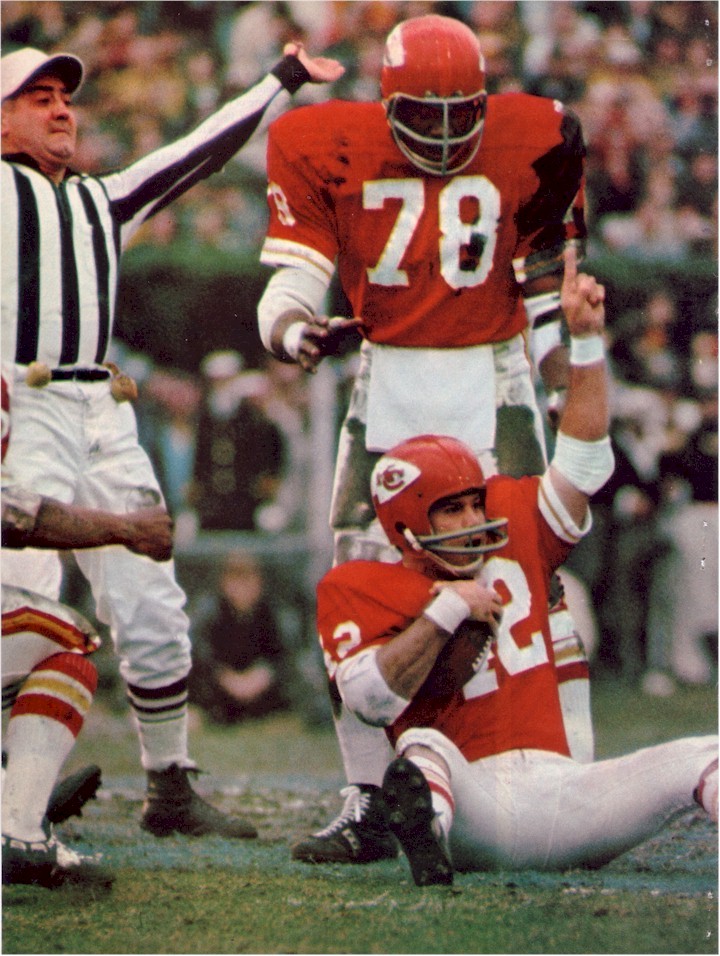
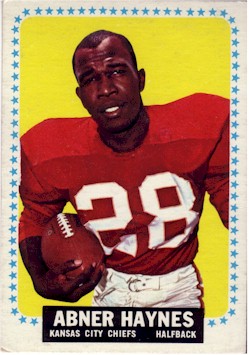
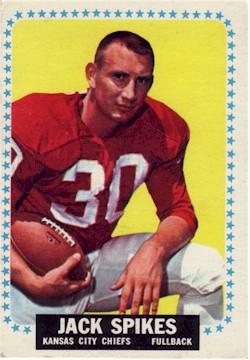
When the defending champion Oilers were stunned by the Texans 26-21 on October 1st, 1961, not one, but two Texan running backs gained over 100 yards against them: Abner Haynes (117) and Jack Spikes (146).   After a  disastrous 5-week start (1-3-1) to the 1961 season, a new coach emerged.   Wally Lemm revitalized the Oilers and they went undefeated the rest of the way, and repeated as champions.

98AbnerHaynes250w.jpg (35280 bytes)

106JackSpikes250w.jpg (35384 bytes)

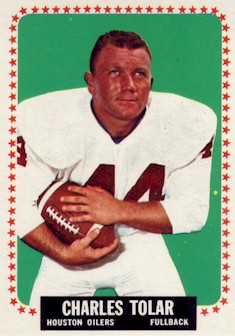
1964Topps86CharlieTolar250w.jpg (29760 bytes)

In their final year in Dallas in 1962, the Texans' defense, led by middle linebacker Sherrill Headrick, made the necessary plays to earn a spot in the title game.   After a 6-1 start, the Texans began the second half of the schedule with a 14-6 loss to their nemesis the Oilers, as the "human bowling ball" Charlie Tolar gained 110 yards.    The Texans gained revenge against the Oilers in a six-quarter championship classic (20-17).

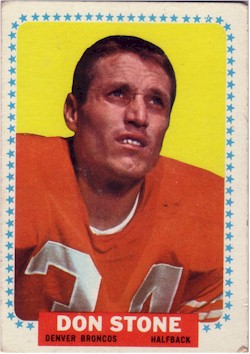
62DonStone250w.jpg (31173 bytes)

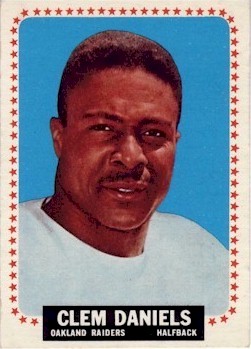
After an injury-plagued 1962, the Chargers rebounded to win the title in 1963 with a defensive line led by the legendary Ernie Ladd and Earl Faison.   Early in the season, though, Donnie Stone became the first Bronco ever to gain over 100 yards in a game, and Denver shocked San Diego 50-34.   Three weeks later the league rushing champion Clem Daniels of the Raiders gained 125 yards in their victory over the Chargers

1964Topps136ClemDaniels250w.jpg (30746 bytes)

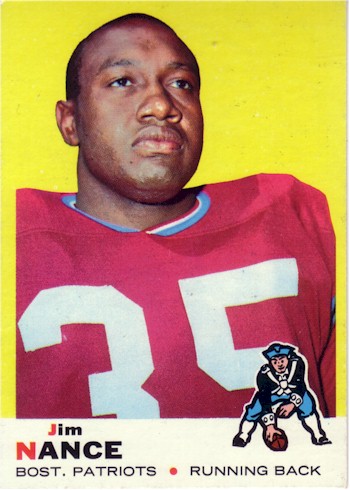
1969Topps70JimNance350w.jpg (51057 bytes)

From that point on, through the end of the decade, only one man would gain over 100 yards rushing against any of the league champions; that man being two-time league rushing champion Jim Nance (107) of the Patriots against the Chiefs in a 27-all tie in 1966.

For two seasons, 1964 and 1965, no team in modern professional football history defended the run better than that stalwart bunch from Buffalo.  

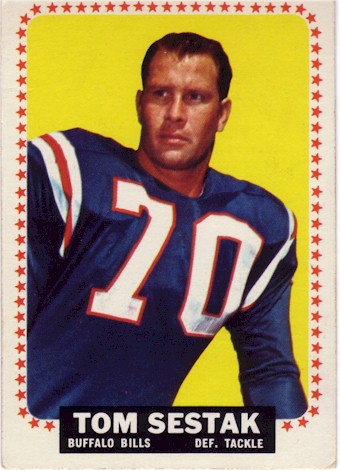
Not only did no one rush for 100 yards against the Bills, but for 17 consecutive games, including the 1964 American Football League Championsip Game, Buffalo did not allow anyone to run for a touchdown (a pro football record that will probably stand alone forever). Most AFL historians can rattle off the individual names of that excellent Bills defense, but one man does stand out: Tom Sestak.    Is "BIG SES" the best defensive tackle in the modern era not in the Hall of Fame?    Rather than debate this, find some film of the '64 - '65 champion Bills and watch him defend the run.

1964Topps37TomSestak250w.jpg (54572 bytes)

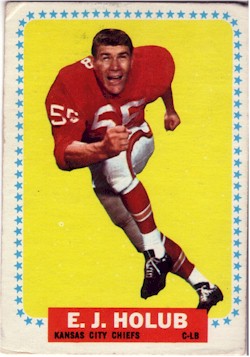
1964Topps100EJHolub250w.jpg (32030 bytes)

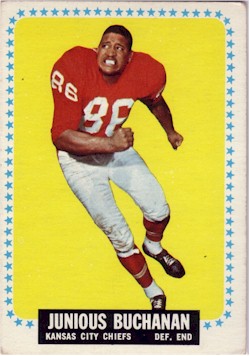
The Chiefs of 1966 defeated Buffalo in the AFL title game to earn the right to travel to Los Angeles for the first AFL-NFL World Championship Game.  The Chiefs' linebacker corps of Holub, Headrick, and Bell all made the AFL West all-star squad, along with d-linemen Buchanan and Mays.    

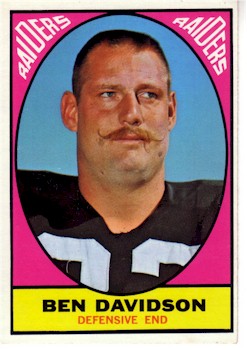
When Al Davis took over the Raiders in 1963, he knew that the d-line must be improved, since 10 opponents had gained over 100 yards rushing against the hapless Raiders of 1962.   Known as "11 angry men", the 1967 Raiders did not allow a 100-yard rusher in compiling their outstanding 13-1 record.  

1967Topps116BenDavidson250w.jpg (30852 bytes)

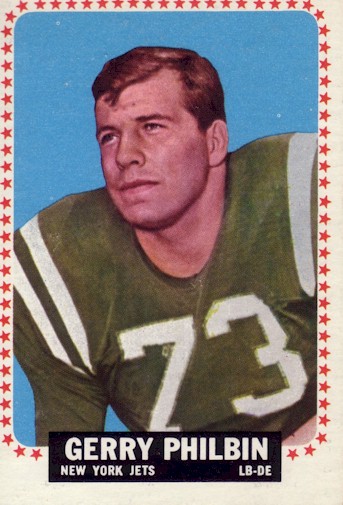
1964Topps123GerryPhilbin250w.jpg (60766 bytes)

The Raiders were not able to defend their AFL title against the Jets in 1968, and while the Jet offense earned the headlines with Joe Willie and company, the Jets d-line with all-stars Biggs, Elliott, and Philbin shut down the opposition on the ground, and no runner gained 100 yards against them.

In a tough, hard fought 1969 playoff game, the Chiefs defeated the Jets 13-6, and then defeated the archrival Raiders 17-7, to advance to the World Championship as the decade was about to close. The Chiefs' "stack" defense, comprised of all-stars Culp, Buchanan, Lanier, and Bell, did not allow a 100-yard rusher.   Thus, in three championship seasons, if you did not have a 100-yard rusher against the Texans/Chiefs your chances of winning were just 19.5%.

92BuckBuchanan250w.jpg (31526 bytes)

In summary: teams with a runner who gained 100 yards rushing against the eventual league champion had a record of 5 - 0 - 1; those without a 100-yard runner were 22 - 110 - 1.   If you did not have a runner gain 100 yards rushing in the decade of the AFL, your chances of defeating the soon-to-be champion were very slim. The moral: stop the run, and win a championship!

TJ Troup played college football as a defensive back at Millikin University.   He coached high school and community college football in California for 20 years.   TJ has worked with Steve Sabol at NFL Films, and Dr. Z (Paul Zimmerman) at SI.   He has had articles published in Coffin Corner, Coaches Quarterly, and the Wall Street Journal.   Troup may be reached at nospam.zeuglodon44@cox.net.
 

.


Ode to the AFL
by Mike Murphy

April 7, 2005


They started with eight
Bills, Patriots, Titans and Oilers
Broncos, Chargers, Raiders and Texans
In Super Bowl III the
Jets were spoilers

Babe, Bambi and Buck
The NFL would snub
Cookie, Golden Wheels and Speedy
They played for the 'Foolish Club'

Bye bye Balboa
So long Shea
Gone is the Rockpile
For a decade we enjoyed your stay

Mike Murphy

       Mike Murphy is a St. Catharines, Ontario fan of the Canadian Football League and of the American Football League.
.

.

Mara and the AFL
by Howard Wexler

November 23, 2005

Gentlemen:

I was just reading the Journal-News from a couple of weeks ago in which you all paid tribute to Wellington Mara, may his soul rest in peace.

From all accounts, he was a gentle and good man who was a great leader in making the NFL what it was today.

But he was not perfect and all the stories and tributes neglected to talk about how he cost his fellow owners millions in the AFL-NFL merger.

Mara and the hard-liners did not realize the AFL was here to stay, even after they signed the huge television contract with NBC. But in that, he had a lot of company.

In the mid-60s, Mara signed Pete Gogolak, who had been with the Buffalo Bills of the AFL. While the two leagues did compete furiously for college players, there was a gentleman's agreement that once a league signed a player, that was that. The other league would not try to sign that player anymore.

Mara broke that agreement by signing Gogolak. That infuriated the AFL owners who hired Raider owner Al Davis to be their new commissioner under a platform of signing the NFLs best players to AFL teams. Thanks to Wellington Mara, there was no more gentleman's agreement.

Within weeks, Mike Ditka, John Brodie and Roman Gabriel had signed with the AFL. Even the hard-headed George Halas realized the NFL was in a no-win situation and the merger took place soon afterwards.

In other mergers of sports leagues (NHL-WHA, ABA-NBA, NFL-AAFC), the newer leagues lost many teams and identity. All of the AFL teams were taken in by the NFL and the merger terms were far better than any other mergers before and since.

We all know that the NFL has not left a penny on the bargaining table for decades. So it makes sense to believe that their backs were pushed against the wall in this negotiation. And the events brought on by Mara's signing of Gogolak severely weakened the NFL bargaining position, costing him and his fellow owners millions of dollars in the merger.

When a public figure passes away, you do speak good about him. But you do not completely whitewash his career either.

Howard Wexler
Howard Wexler is a fan of the American Football League who recently sent the above letter to New York City area writers.

.

Thank You, Jets!
by Michael Bordonaro
February 21, 2006

          I was born in 1959, so I have only a partial memory of the AFL.   I remember my dad taking me to a couple Buffalo Bills games every season.   I think my first year was 1966.  
          The game I remember most though was the one where the NY Jets came to Buffalo for a game in 1969.  When the Jets came onto the field at Buffalo’s War Memorial Stadium, I can still remember how the Buffalo fans stood up from their seats and gave the Jets a long ovation.   As a confused 9-year-old I asked my father why our fans were cheering for the Jets as they took the field.   He didn’t answer me.   As I looked up at him to ask him again, he just stood there and clapped – and I noticed a tear running from his eye.  
          When I got older I realized what that was all about: NY Jets 16 – Baltimore Colts 7.
 

.

Kick-Return Club
Essay by TJ Troup

Technical Advisors: Ken Pullis and Pete Palmer
June 20, 2006

When the eight teams of the AFL began play in 1960 the emphasis was on offense.  As the league achieved stability coaches paid more attention to defense.  But, what about special teams . . . . namely, the kick return aspect of the game?  This essay will examine the best kick return men during this exciting decade.

Since roster space was limited, most teams used running backs and/or defensive backs to return kicks.   During the AFL decade, there were 2,730 punt returns for 24,942 yards, and 4,810 kick-off returns for 107,574 yards.  The average punt return was 9.13, and the average kick-off return was 22.36.  A punt return of 30 yards, and a kick-off return of 44 yards, will be the criteria defining a "long" return.

Ken Hall of the the soon-to-be-champion Houston Oilers set the record for most long kick-off returns in a season with 5 during the 1960 season (his record would later be tied by another Oiler . . . . . Bobby Jancik, in 1963).

The Denver Broncos lost to the Patriots 28-24 at Bears Stadium on December 3rd, 1961.  The significance, you ask?  Al Frazier of the Broncos returned both a punt (55 yards after a lateral from Bob McNamara), and a kick-off (90 yards) in the same quarter (4th). He is the only player in pro football history to return both a punt and a kick-off for a touchdown in the same quarter. Possibly Al was trying to outrun his vertically-striped socks?

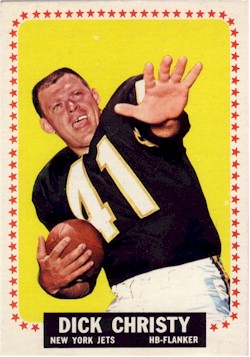
As impressive as Frazier's feat is......Dick Christy of the New York Titans accomplishment against the above mentioned Broncos compares favorably. He not only returned two punts for a touchdown against Denver on September 24th, 1961 at the Polo Grounds; he also is the only return man in pro football history to have 3 punt returns of at least 60 yards against a specific opponent in a season.

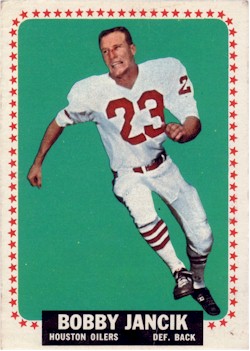
The Houston Oilers began the 1962 season as two time league champions, and new to the roster was defensive back Bobby Jancik from tiny Lamar Tech. Over the course of his six year career Jancik would establish seasonal and career league records for kick-off returns, and combined kick return yardage. Jancik gained 4,185 yards on his kick-off returns, and 10 times he would "break" a long return, yet, amazingly he never returned a kick-off for a touchdown!

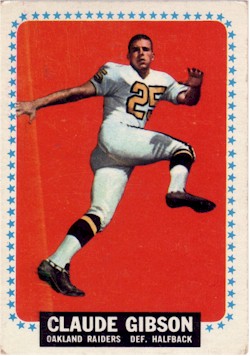
When Al Davis took command of the Raiders in 1963 he inherited a team in complete disarray.  One of his early and best acquisitions was cornerback Claude "Hoot" Gibson of the Chargers.  Gibson led the league in both punt return average and yards returned in 1963 and 1964 for the Raiders.  Both Rodger Bird and George Atkinson continued a Raider tradition of establishing league records under Davis.  One of the most overlooked aspects of the Raiders success was their ability to limit opponents on punt returns.

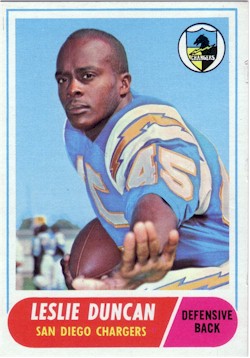
From 1963 through 1969, Raider opponents returned 257 punts for just 1,669 yards (6.49), and NO touchdowns!  Only 5 times on those 257 returns did an opponent have a punt return of 30 yards or longer. Even Leslie "Speedy" Duncan of the Chargers; the most successful return man of the decade could not break a "long" return against Oakland.

Since he was just mentioned . . . . let us examine Duncan's career with the Chargers. Speedy Duncan is the only return man to have at least 20 combined long returns; 13 on punts, and 7 on kick-offs.  Duncan had the most combined kick returns (248) in AFL history, for the second most yards (4,617).  Speedy Duncan and George Atkinson are the only punt returners in league history to break 3 long punt returns in a game; Atkinson against Buffalo in 1968, and Duncan against Denver in 1967.

Just two men led the league in both punt and kick-off return average during the AFL decade. Abner Haynes was a league MVP as he excelled both running and receiving. Haynes also led the league in punt returns in 1960 with the Dallas Texans, and kick-off returns in 1965 with the Denver Broncos. During his eighth and final season in 1967 Abner had a 48 yard kick-off return for the Dolphins on October 15th, and a 51 yard kick-off return for the Jets on December 17th. The significance is that the Boston Patriots were the victims both times.

Thus, Haynes is the only player to have two long kick-off returns against the same opponent while playing for two different teams. As the decade and the AFL came to a close in 1969; rookie cornerback Billy Thompson of the Broncos led the league in both punt- and kick-off return average (and is the only player to do both in the same year).

[Note from the Webmaster:  Above, TJ covers only regular-season games.  In my book, the best, most exciting return in American Football League history was the return of Charger John Hadl's punt by the Bills' Butch Byrd in the 1965 AFL Championship Game.  Byrd caught the ball on the Bills' 26-yard line, and with outstanding blocking, took it 74 yards for a touchdown. The last two blocks were by Bills linebacker/punter Paul Maguire, who crushed two Chargers, Hadl and Dave Kocourek, to spring Byrd free. - Remember the AFL ]

TJ Troup played college football as a defensive back at Millikin University.   He coached high school and community college football in California for 20 years.   TJ has worked with Steve Sabol at NFL Films, and Dr. Z (Paul Zimmerman) at SI.   He has had articles published in Coffin Corner, Coaches Quarterly, and the Wall Street Journal.   Troup may be reached at nospam.zeuglodon44@cox.net.
 

.

THE UNDERDOGS HAVE MADE IT
by Robert H. Boyle
September 17, 2006

      Read about you today in The New York Times.  In the summer of 1960 I was a senior writer for Sports Illustrated in NY, and just for the hell of it on a day off, I drove up to Cambridge, Mass., where I saw what I believe was the first exhibition game ever played in the AFL.  It was between the Boston Patriots and the Dallas Texans.  The only player I remember from that game, and my memory may be faulty, at Harvard Stadium was Ger Schwedes who had played for Syracuse.
 
      Back in Manhattan I did a profile of Harry Wismer who owned the Titans (now the Jets) that fall for SI.  Went to a couple of Titan games at the Polo Grounds --- Sammy Baugh was the coach and Al Dorow the quarterback --- where plump Wismer would stride up and down behind the bench in a trench coat like Hermann Goering on review.  Crowd was lucky to be 2,000, 3,000.  Wismer would paper the house by giving away reams of tickets.  He thrust a bundle of them on me --- in no way was this payola! --- and I gave them to conductors I knew on New York Central commuter trains, one of whom (and maybe more than one), said to me, "Why would I want this crap?" Flew with the Titans to Buffalo for a game in that old ramshackle War Memorial Stadium. 
 
     Tex Maule, who covered the NFL for SI, disdained the AFL.  Disdained?  Tex, a friend of mine, had utter contempt for the new league.  I thought the league could make it.  Earlier in the year before returning to NY, I was SI's West Coast correspondent (my territory, I was told, extended east to the Jersey side of the Hudson River ) and I remember the first announcement of the new league.  Oakland was to have a team called the Senors!   Wayne Valley (who grew to detest Al Davis) was the (an?) owner, and I recall that Frank Leahy was somehow involved.
 
     Given Maule's contempt for the AFL   Andre LaGuerre, SI's great managing editor, had me cover the AFL now and then.    Flew with the Titans to Buffalo for a game in that old ramshackle War Memorial Stadium.   After a game in Buffalo, in which the Bills drew 30,000 or so, LaGuerre wrote himself happily wrote the headline on my story, stating: THE AFL HAS MADE IT. Joe Foss, the commissioner, had the story framed and hung in his office.
 
       Later I wrote the cover story about Namath (his photo taken on Broadway inspired his nickname Broadway Joe), Sonny Werblin and John Hadl.   It was called "Show Biz Sonny and His Search for Stars."  Sonny is the man who made, absolutely MADE the AFL with the NBC contract.  And he made the Jets, too.  Too bad his partners got jealous, Sonny got ticked off by their attitide, and he sold out the year before the team won Superbowl III.  The Jets went downhill soon after that win with Sonny out of the picture. 
 
       I was assigned to do Sonny's memoirs about the AFL (he later decided not to go through with it)  and watched Superbowl IV at his apartment.  I remember Johnny Carson, who also lived in the building, knocking on the door and talking to Sonny for a couple of minutes,  at half time, I recall.  But what I remember most all from that game was watching Jan Stenerud kick a field goal  that must have been a cannon shot into the heart of the Vikings. 
 
      Re the Jets in the Superbowl.  Down in the spread by 18 points, the team was a joke to Tex Maule who assured me that the Colts would demolish them.   Ha, ha, ha, I remember slamming my fist (and hurting it) in joy against my ceiling at home when Snell went into the end zone!  Tex didn't show up in the office for almost a month.  Ha, ha, ha! 
 
         Viva the AFL!   Viva your website!
 
         Best wishes,
 
         Robert H. Boyle 
         Cooperstown
 
    PS And let us not forget Cookie Gilchrist, Golden Wheels and Bill Mazer.
 
Robert H. Boyle was a writer for Sports Illustrated in the 1960s.  The SI article he refers to above is at AFL Clippings.

.

STRANGER THAN FICTION
by Jeff Lucas
October 20, 2006

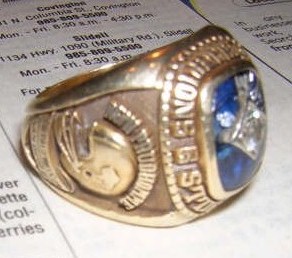
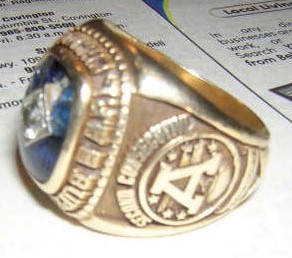
       Jeff Lucas, a plumber in Louisiana, recently was digging a ditch and found a 1965 Buffalo Bills American Football League Championship ring that belonged to the late Remi Prudhomme.  Wanting to return the ring to the Bills or to Prudhomme's family, he contacted the "Professional Football Researcher's Association" web forum.  He was met by ridicule and disbelief by the PFRA, but he persevered, and recently sent this e-mail in response to one from Remember the AFL:

thanks for the email, here's kind of a quick run down as to what happened. 
ms. alice casserta (80 years old) on 14th street in covington [Louisiana] needed a gas line for her generator, seeing that she is on breathing treatments and power
goes out here quite often when damaged trees from hurricane katrina fall
down simply from a high wind.   as i kneeled down to tie the gasline into the
meter i saw a piece of brass [gold] sticking out of a piece of dirt.   i picked it up
and started chiseling away the dirt with my knife and was amazed at what i
found [Prudhomme's AFL Championship ring] a couple of days later i went back to ms. casserta's house and told her what i had found and she almost fainted, i thought i was going to have to call for an ambulance.   remi lived right next door to ms. casserta and she even recalls when he lost the ring.   she said they looked and looked for it in both yards and never found it.   ms. casserta knew the prudhomme's very well and still talks to his ex-wife who lives in baton rouge, la, so we called her up to let her know the details of the events that took place, and
she was very happy that it had been found and that her kids would be able to
have it.   remi's son renč has his kansas city 4th superbowl ring so their
family decided that remi's daughter would receive this one.   that's the short
story.

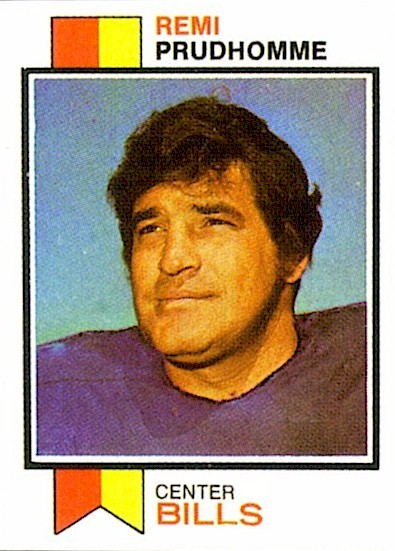
            Remi Prudhomme, an All-American offensive lineman and a member of the "Chinese Bandits" at LSU, was drafted in 1964 by the American Football League's Buffalo Bills.  Although he was on the Bills' "taxi squad" for 1964 and 1965, the team awarded him a 1965 AFL Championship ring, and he is in their 1965 Championship photo, though he did not play his first official AFL game until 1966.  Prudhomme later played for Kansas City.  In the Fourth World Championship Game, he recovered a Vikings fumble at the Minnesota 19 to set up a Chiefs touchdown in their crushing defeat of the NFL champions, who had been hailed by the "experts" as "the greatest team in pro football history". 
             Prudhomme died December 6, 1990, at age 48.
            Although Jeff Lucas was offered $3,500 for the ring, he did the right thing and arranged to return it to Remi's family.  Kudos, Jeff!

.

How I Discovered the AFL
(or: Football is Football)

by Steve Fowler
March 14,2007

          I have wanted to share this with someone who would be interested for quite some time.  You seem like a viable candidate.
          I grew up in northern Westchester County in New York State.  My dad turned me on to football in the fall of 1967, when I was just turning eight. He was an NFL fan. I needed a favorite football team, and he suggested the Giants (his team), so that was that, as far as a favorite team was concerned.  However, I think that even then, I was a football fan first, and a Giants fan second.
          My dad told me about the great Green Bay Packers, with their great head coach Vince Lombardi and their quarterback Bart Starr.  He also told me about Johnny Unitas. Starting to watch football then, that was what I had to go with.  He sat me down to watch a game on TV., which was a Giants game (I don't recall the opponent).  They had to have been on the road, since their home games were blacked out.  He showed me how the quarterback takes the ball from center and that he either hands it off or passes it, unless he keeps it himself.  I picked up on all of the rules over the course of a few weeks.
          With the Giants as my favorite team, I was turned on to Fran Tarkenton, Tucker Fredrickson and Homer Jones.
           I was at the age when I was all about baseball cards during baseball season.  My allowance was ten cents a week.  My parents dragged me off to church every Sunday morning, which put me within walking distance of the Luncheonette in our town after Sunday School.  I decided that I wanted to buy football cards with my ten cents.  After church one Sunday morning, I charged over to the Luncheonette with my allowance and bought two packs of football cards.  I was all excited, hoping to get some New York Giants players amongst my cards.
           It was a little disappointing not to get any Giants, but I did get a Jet named Verlon Biggs (I had heard something of the Jets, growing up outside of New York City).  Curiously, I didn't recognize any of the other teams.  This is all sort of a guess now so many years later, but I want to say that I had Jerry Mays, Wahoo McDaniel, Ron Mix, E.J. Holub, Babe Parilli, Bob Talamini, Pete Sestak, Kith Lincoln, and Dave Costa in addition to Verlon Biggs in my two packs of cards.  I was all charged up, and couldn't wait to show them to my dad.  When I did, he said, "Oh, that's that other league, the AFL. They're not as good as the NFL."  I was upset. I had spent my ten cents, and I was happy with my football cards.  My dad was spoiling it for me.  My mother wasn't at all up to speed on any of the AFL / NFL going's on, but she told my dad not to make me feel bad about my football cards.
          Later on, I charged downstairs to the basement (where we had our TV) to watch the football game.  The games were always on channel 2 (or so I had been told).  I want to say that the first game was the Eagles and the Redskins, and the second game was the Giants and the Rams.  In any event, there were two games, so I had a full day of football.  The next week, there was a game on at 1:00 (let's just say the Lions and the Vikings for the sake of argument), but when it got to be 4:00, there was no second game.  I was deeply distraught by this.  How could there not be a second game?  It was Sunday!.  There was supposed to be a second game!  Instead, I was getting treated to Picture for a Sunday Afternoon.  Despondent, I figured I would just go back upstairs and read my comic books, but before I did, I decided to flip through the channels once through in an act of futility.
           Channel 3 was fuzz.  Channel 4 had a car commercial, so I would check back on that. Channel 5 had a movie.  Channel 6 was fuzz.  Channel 7 had another movie.  Channels 8 - 10 had fuzz.  Channel 11 had poor reception but was another movie anyway.  Channels 12 & 13 were fuzz.  I flipped back through channels 2 and 3, and back to 4.  I waited for the car commercial to end.  It was followed by a shaving cream commercial, and finally returned to its scheduled programming.  A football game!!!  Man, was I charged up!!  The uniforms looked different with names across the back, and the field had shield emblems every ten yards. The end zones had an argyle pattern to them.  I didn't care.  It was football!!  I want to say it was the Patriots against the Raiders.  Matter of fact, I had to admit that the names across the back and the emblems on the field were "cool" compared to what I was seeing on channel 2.
         I would not characterize myself as having been an AFL fan or an NFL fan.  I was a football fan.  From discussions with my classmates (this would have been while I was in 3rd grade) I would say that the sentiment was mutual and universal.  Many of our fathers were probably stuffy NFL fans, but we just wanted to see a game.  Any game.  We did not differentiate between AFL and NFL.  None of us really considered the NFL to be better than the AFL.  I got to know the AFL teams and players just as well as those in the NFL.
         I still have a strong memory of watching the Ice Bowl game at my grandparents house.  I was mesmerized.  I think that was when I began loathing the Cowboys, because before that, I thought Don Meredith and Bob Hayes were exciting to watch.  I just couldn't root for them against the Packers.  The Packers had an aura about them.  They were disciplined.  Lombardi reminded me of our high school team's coach.  He was tough.  He demanded that every player give their best on every play.  To me, the Packers deserved to win.  I also felt they deserved to win when they played the Raiders in the Super Bowl.  I was happy for Lombardi when his team carried him off the field on their shoulders.
          This is not to say that I disrespected the Raiders.  To the contrary, I really liked Daryl Lamonica, Hewritt Dixon, Fred Belitnikoff, Jim Otto, and Ben Davidson.  I liked them, and I liked their league.
           I would like to share more of my musings with you, picking up with my thoughts on the great 1968 season.  I will save this in my sent mail, and pick up where I am leaving off now, when I get a chance.

.

How I Discovered the AFL
(or: Football is Football)

PART II
by Steve Fowler
March 22,2007

          I hope that when I die and go to heaven (God willing), they have AFL football games there.  I would like to go to Nippert Stadium and Municipal Stadium, although I'm not in any big hurry to go to the Astrodome.
          I have some vivid memories of the 1968 season to share now.  I remember having to go back to school in early September.  The regular season started later back then, when they only played fourteen games.  Exhibition season was still going on when school started. One of my schoolmates related to me that the Kansas City Chiefs had shellacked the Chicago Bears in an exhibition game.  I was pretty charged up about that.   It's not as easy to put something like that in historical perspective when you are nine years old, but I knew it was significant.  Looking back, I can see how a good team can lose a game by a big margin if they are off their game in any given week.  However, there is no way that a bad team is ever going to win like that.  It was apparent to me that the Chiefs were a good team.  There were plenty of NFL fans around to pooh-pooh that game as being "just an exhibition game", but by then, they had to start getting an uneasy feeling in their stomachs.  The times, they were a-changin'.
          Once again, I couldn't wait for the Topps football cards to come out.  I was a little put off by the fact that that there was no longer an AFL collection of cards, separate and distinct from the NFL cards.  They were all thrown together in one "pro football" collection.  I wasn't all up to speed on the fact that a merger was in the works yet, and probably didn't have a grasp on what it meant to have a "common draft".  So be it.
          I remember the Heidi game pretty well.  I can't say I was beside myself when NBC cut away from the game to Heidi.  Bemused would better characterize my reaction.  When the game signed off, I went upstairs and turned on the radio.  I was a little disappointed in the Jets implosion, but mostly I was shaking my head in amazement.  My vocabulary had probably gotten a bit more "colorful" by then, with some "adult" words available for specific situations.  If I could put my thoughts into words for that travesty at that time, I think they were, "Boy is the s#%^ going to hit the fan!"  We all got a pretty good laugh over it the next day in school.
         Fast forward then to Super Bowl III.  As a rule, I am not and never have been a big fan of hot dogs or people who brag.  Somehow though, it was different with Joe Namath.  I was proud of him for sticking up for his team before the Super Bowl.  They were getting disrespected in a big way.  I have seen interviews with him reflecting back on his guarantee, and I find it interesting that it was not something that he planned. It was just something that happened, in the heat of the moment.  It's easy to understand.
         Looking back, a case could have been made at that time for Len Dawson, Daryle Lamonica, or John Hadl being as good a quarterback as Joe Namath was, perhaps even better.  However, I don't know that any of them had the cockiness that Namath had.  Put one of them in his place the week before the game, and maybe they would be saying something like, "we have a good chance" or, "we expect to be competitive".  Such comments, while they might express confidence, weren't going to do it in the face of the fact that the AFL team (the Jets) really had two opponents that week; the Colts, and public perception.  Namath told the public what they could do with their perception.  Because of Namath, the Jets had already beaten their first opponent, before the opening kickoff.
          I recently got to watch the original NBC telecast of Super Bowl III.  I could still feel the emotion building throughout the game, just as it did when I was a kid.  However, this time, I got to watch it with the benefit of 38 years of experience studying football.  That made it a little different.  I could tell that with the exception of a handful of times when Tom Matte broke some long plays, the Jets dominated the line of scrimmage throughout the game, on both sides of the ball.  They flat out beat the Colts up.
           You still hear whisperings about Earl Morrall being on the take, and about that flea flicker pass at the end of the first half that got picked off.  That's bunk.  Morrall played hard.  He wanted to win.  I'll tell you what I think, now.  If Morrall finds Orr open, Orr catches that pass and scores, the final score is Jets 16 - Colts 14.  And such a score would not do justice to the reality, which is that the Jets were clearly the better team on that day.
            All hail Namath, the 1968 Jets, and the AFL.  They made pro football great.

.

The Passing of Two Ernies

by Michael Miller
March 23, 2007

          After Ernie Ladd's passing last week, the Charger Family suffered yet another setback Tuesday with the death of an original Charger; Ernie Wright.  Ladd played in the AFL from 1961 through 1968, while Wright played in all ten years of the American Football League's existence. Ladd finished his AFL playing career as a member of the Kansas City Chiefs,  Wright as a Cincinnati Bengal, though he returned to the NFL Chargers for the 1972 season.
          The Ernies' playing careers will be 'highlighted' by their years on those great Charger squads of the early sixties.  Ernie Ladd was the 'anchor' of the original 'Fearsome Fearsome' Defensive Line, and in the words of Charger Coach Sid Gillman; "Having Ron Mix and Ernie Wright as our offensive tackles gives the Chargers the best pair of tackles in the League'.
           Numbers 75 (Wright) and 77 (Ladd) have started another journey together but the paths they created wearing Charger uniforms will always be appreciated, respected, and fondly remembered, by those fortunate to have seen both 'Ernies' play, at the 'peak' of their skills, on those sunny Fall afternoons, spent at Balboa Stadium, some forty years ago.
           Rest In Peace, 'Ernies', God Bless and 'Thank You'.

.

An AFL Waterboy Remembers

by Gary Braverman
August 6, 2007

Editor's note: Bob Boyle, who wrote stories on the American Football League for Sports Illustrated in the 1960's (see above), suggested that I contact Gary Braverman, son of sports impresario Al Braverman, for his thoughts about Harry Wismer and the early Titans of New York.  Gary responded with the following essay, presented exactly as he wrote it, except for a few euphemisms for his colorful expressions, and some [editorial comments] by me.  The opinions  are those of Gary Braverman and not (necessarily) those of the webmaster.

Dear Bobs Friend,
Harry Wismer was a cheap #@$&!!..Never received dime one from him for my duties as Waterboy for the NY Titans Football team..I did however get a Titans Jacket because as my father put it to Wismer..(and the Old Man was noted for his stance to take NO ?%#@ from anyone, He was one tough Jew) he told Wismer that his son was freezing his %@$#& off and he'd better do something about it..and Quick!..Al Darrow [Dorow] was Great but laid back but one of the funniest (in the lockerooms after a game were 2 guys..One a speedy rebel tight end [wide receiver] named Don Maynard..the other was a real &%$#up but funny as hell...He was the kickoff guy or the field goal guy..and he was the worst.I mean really the worst.His name if I can remember was Joe Paglia.or Peglia [Pagliei].I remeber once he picked up a fumble and ran the wrong way giving opposite team a touchdown..He could not kick a lick but boy he could crack you up in the lockeroom..Another memorable instance was the Titans Center..A Giant of a man..Big Brute [Pole]..cannot remember his name [Mike Hudock] but he called out WATERBOY Get the &%$# over here..I was so dumbfounded by this monster screaming my name I ran over to him and stuck or jammed the metal nozzle in his mouth instead of keeping nozzle a few inches away and spraying water..Windup is I busted his front teeth and he chased me all around the bench for a few minutes cursing and telling me how he was going to break me in half..Most memorable player to me was .Art Powell..and on the other end Don Maynard..
Never received any money from Wismer..My Dad intimidated him to give me the job..At the time My Dad was still blackballing the Garden because the mob was running it..Frankie Carbo and Blinky Palermo..It was a given that Big Al Braverman was one mad hatter Jew who could stretch you out with one punch..My Dads close friend actually was responsible for talking Wismer into hiring me..He was a Great narrator with one Bum Leg..His name I remember quite well was Steve Ellis and he had 1 beautiful wife..It was a hell of an expierence and wish I could give you more..But it was so long ago...
Regards,
Gary Braverman

.

WHO ARE THESE GUYS?
My introduction to and life-long passion for the American Football League

by Dave Steidel
August 8,2007

           I’m probably not unlike many other baby-boomers who were growing up in the fifties and sixties. My parents introduced me to baseball- and football-card collecting in 1958 when they arrived home from the grocery store one late summer Saturday morning and pulled two wax packs from one of the bags.
         I can still remember that All-Star cards of Mickey Mantle and Jackie Jensen emerged from each; I still have them. As the summer turned into fall and football season made the transition from vacation time to back to school time less painful, my rite of passage into second grade included a weekly jaunt to the corner store with my nickel allowance to purchase a pack of football cards. I had a ton by Thanksgiving and invented games and lineups to stretch every ounce of enjoyment out these newfound heroes. Johnny Unitas, L.G. Dupree, Clarence Peaks and Pete Retzlaff were just a few of those who greeted me each morning as I awoke and were also my last contacts before my nightly prayers and jumping into bed. I was eight years old and was infatuated with the glamour and glory of the sport and times.
           The winter came and went and the arrival of a new spring and summer was also filled with collecting empty soda bottles to return to stores to receive a two cent payoff for each that went into my baseball card fund. The richest feeling I ever had was exchanging twelve bottles one day and racing to the store to buy a mother lode of five-packs of baseball cards. In those days Topps disbursed their sets in a series of seven releases spaced out over the course of the season. Collecting and trading cards was a science back then, and many of us searched the town for stores that received the latest series first, to get a jump on others.
By August of 1960 I was a full fledged NFL supporter waiting for the first delivery of football cards to arrive at my neighborhood store. That’s when the epiphany occurred! All I knew was that the wrapper said they were football cards. And all I was hoping for was a new Jimmy Brown, Lenny Moore or Tommy McDonald. My initial reaction when I opened my first new pack of the season was confusion, then disappointment, followed by more confusion. The gum was always stale, that was given, but what was with the college uniforms and who are the Denver Broncos?
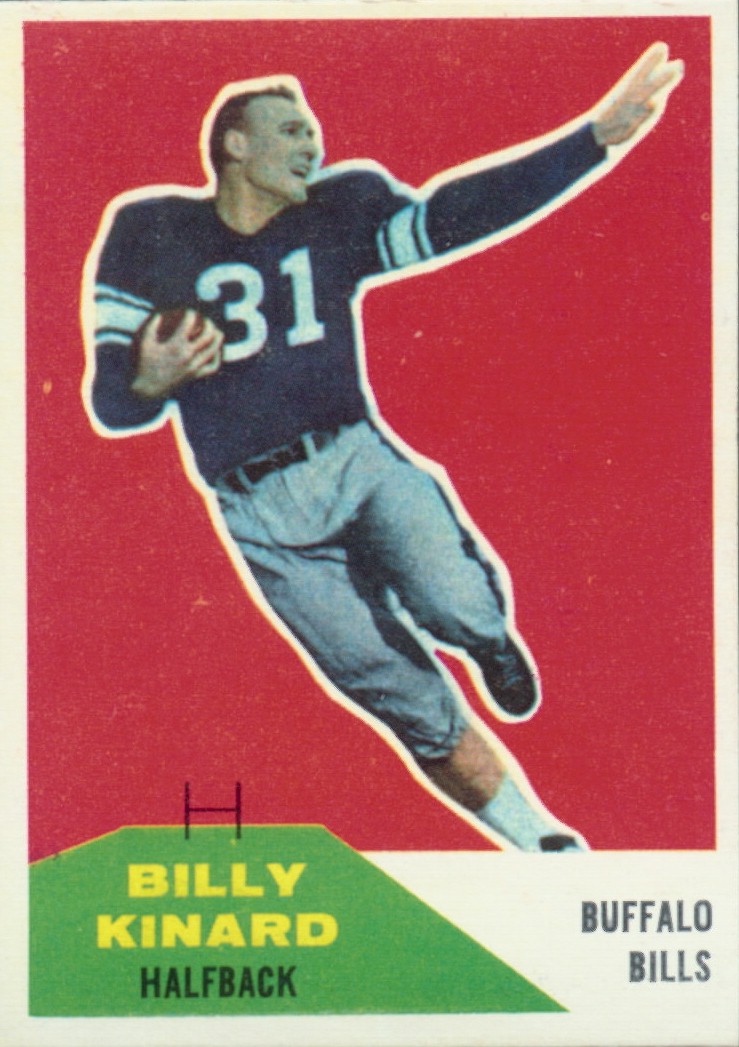
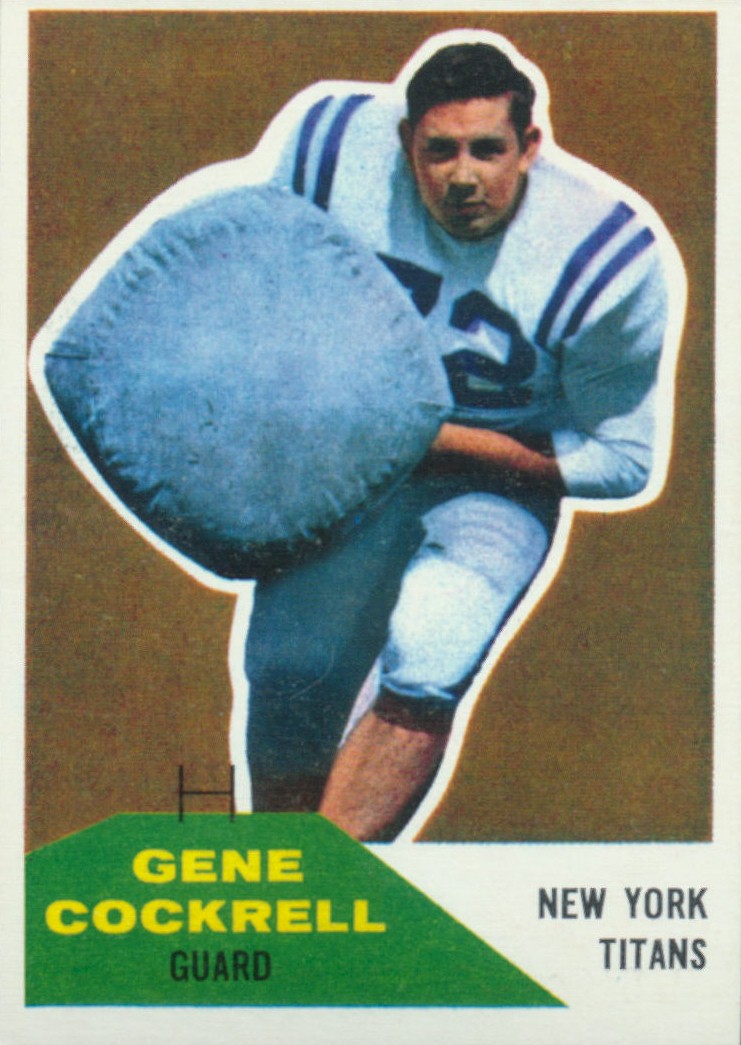
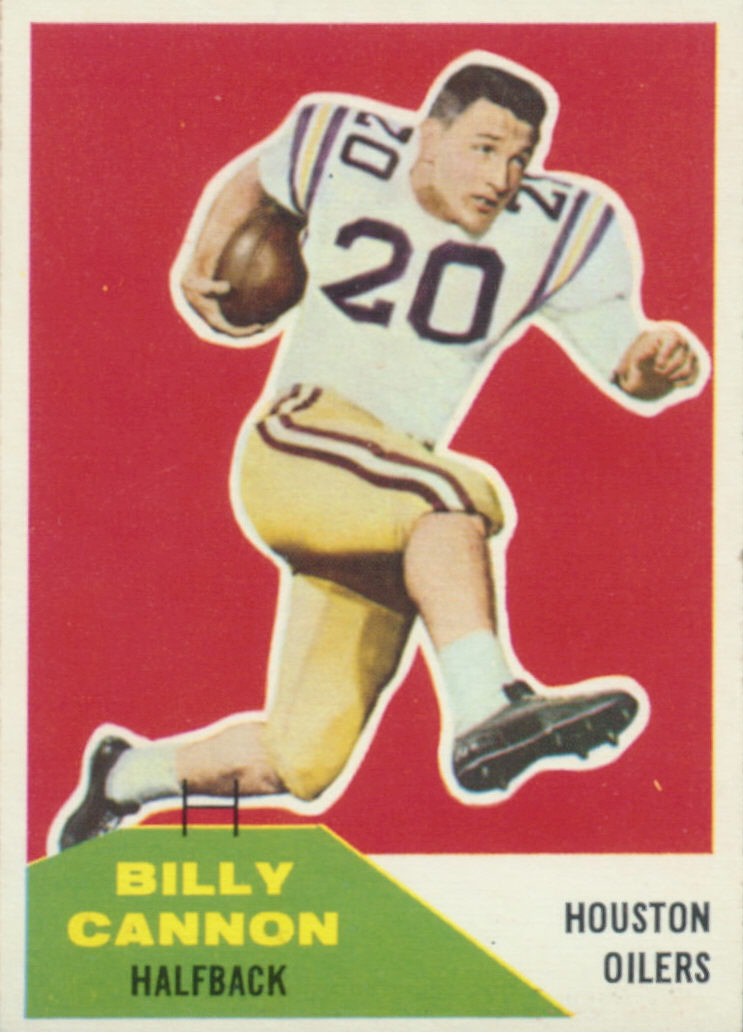
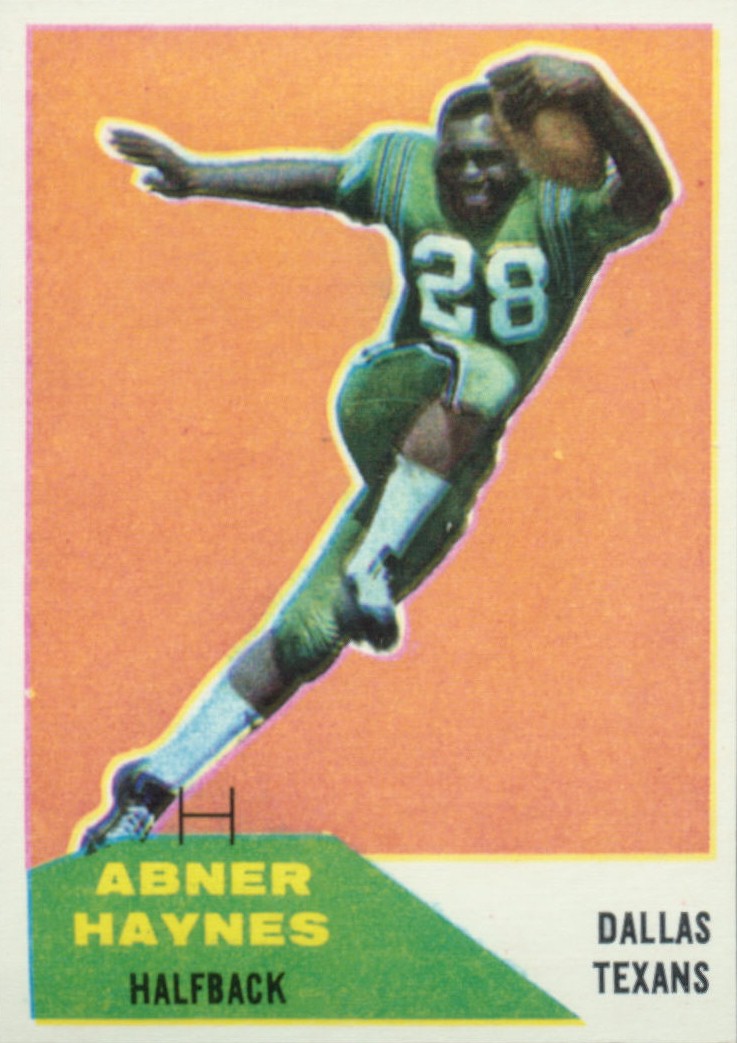
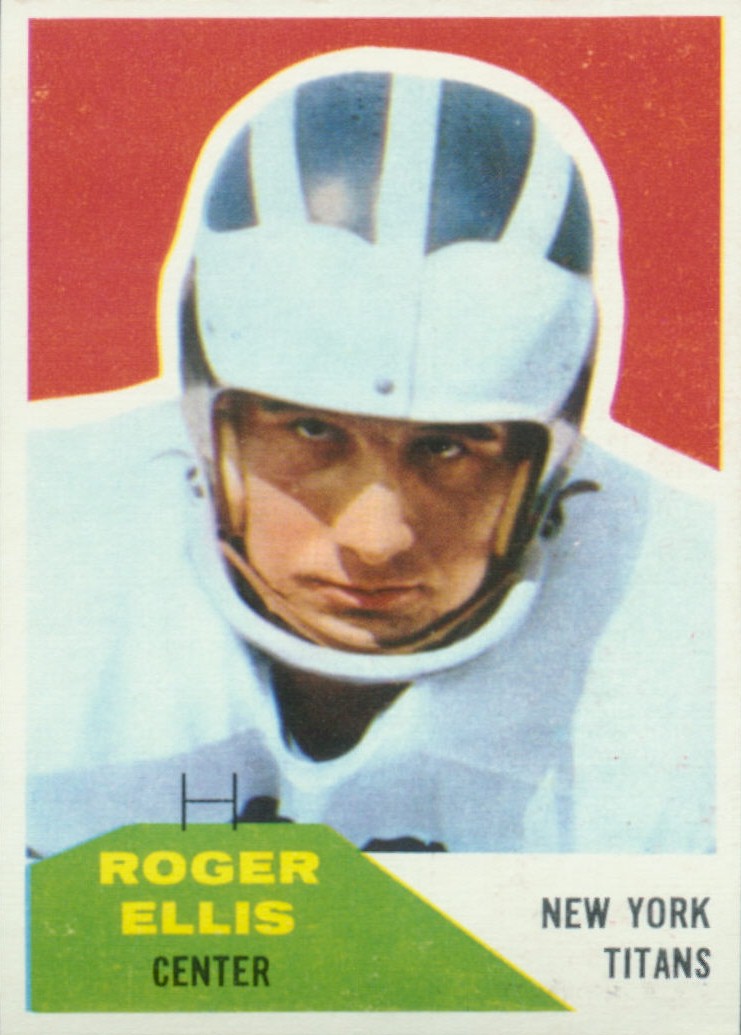
          This was not the NFL, even a nine year old knew that. This was something completely different, but I didn’t know what, or even why. Was the NFL not issuing football cards this year? Did I just waste a hard earned nickel that could have been saved for the real set of cards to come out? Was this the Twilight Zone? Some guy named Abner Haynes was wearing a green uniform, shirt and pants. Roger Ellis donned a Michigan Wolverine helmet, Bill Kinard appeared to be waving to his mother in the stands as he ran with the ball and New York Titan lineman Gene Cockrell was pictured running straight ahead and looked like he was using a blocking dummy as a jousting pole. And then there was Billy Cannon! Now there’s a name I knew. This must be that new league that was starting up – this was the American Football League! Okay, maybe not getting a Jimmy Brown wasn’t so bad.
          The names of Topps and Fleer were irrelevant to this young football fan and I had no idea that the two companies even existed. All I knew was that if the pack said they were football cards then I was buying it. It was another two weeks before the NFL cards arrived, but by then I already had a drawer full of cardboard cavaliers from the other league.
           The Eagles were on the local CBS station that Sunday, but in 1960 our antenna only received NBC and ABC without my father taking me up on the roof and physically turning it so I could see Norm Van Brocklin throw passes to McDonald through an otherwise scratchy, snowy screen. “Just watch the game that’s on the other channel” I was told one Sunday. Better advice had never been given to me. These were the guys I had on all those cards in my card drawer! Although I missed seeing my favorite Eagle wings on the player’s helmets, 'those helmets with the lightning bolts on ABC are pretty cool looking', I thought.
I didn’t even notice on our black and white 17” Motorola that the stripes on Denver’s socks were different, only that their helmets looked like most of the colleges of the day – and man, did their quarterback throw a lot of passes. That too was pretty cool since my local favorite Philadelphia Eagles also passed more than they ran.
           As each Sunday ensued, the need to bug my dad to turn the antenna became less and less important, while watching the team with the lightning bolts and their #23 (Paul Lowe) breaking away for long-distance runs, or seeing George Blanda in that oil derrick helmet pass to Billy Cannon each week, became the pastime of choice. And it stayed that way for the next ten years.
           I was there from the get-go, one of the original card carrying American Football League fans from its inception – and it all started because I bought the wrong pack of football cards.

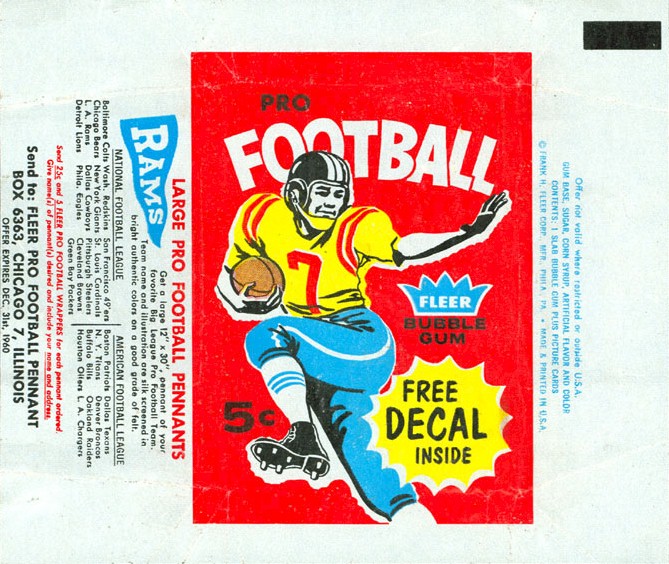
Below are the wax pack wrapper and the five cards that started Dave out as an AFL fan.

Dave Steidel's first book, The American Football League Trivia History, will be published in 2008.

.

An AFL Fan in Chicago?

by Rich Henning
October 28, 2007

          I just wanted to write in to tell you what a wonderful site this is and how special it is for folks like me.  I was a young child growing up in Chicago in the 1960s.  My father was from Kansas City and used to tell me how thrilled he was when pro football came to his hometown.  Some of my earliest childhood memories are of my father and I watching AFL games on NBC. The Chiefs became my favorite team.  When I went to school the other kids would tell me how great the Bears were.  I caught more than my share of grief but my hero was not Gale Sayers or Dick Butkus but Len Dawson.  My dad had a love-hate relationship with the Oakland Raiders and with Joe Namath.   He loved to root against the Jets and the Raiders but when the two teams met for the AFL Championship in January of 1969, I remember us rushing over to my uncle’s house to watch one of the greatest games in history on their big, color TV.
          My father passed away in 1986.  When I think back and remember my childhood and Sunday afternoons with him listening to Curt Gowdy call all those wonderful games, I am taken back to an era that was truly a magic moment in history that can never be repeated. Those of us who remember the AFL sometimes have a hard time explaining to others why it was so special, but if you were lucky enough to have caught the bug, it is for life.  In spite of the fact that many games were played on raw, cloudy days in spartan, rusty stadiums, the AFL is a warm place to return in our memories.  Professional sports today seem so packaged and sterile. It is a far cry from those days when the uniforms were muddy and men like George Blanda or Babe Parilli would draw up plays in the dirt to outsmart Johnny Robinson or Ron McDole (the same plays that today are called by computers to counter defenses, a testimony to the unique ingenuity of those players and coaches).  Unlike today, teams back then stayed together for years and each franchise in the AFL developed a unique flavor. If it were not for Sid Gilman, Lance Alworth and the rest of the Chargers, there would be no “vertical” passing game in modern football.  I know we cannot wake up tomorrow and watch a game on NBC in glorious peacock color from sunny San Diego of 1965, and see that California field that seemed SO green set against those powder blue uniforms, but your site takes us all back to those days.
          Speaking of the fields….George Toma, the groundskeeper extraordinaire of the Chiefs, was yet another innovator that you might want to consider for the AFL Hall of Fame. He was the father of the modern sports playing field.  As a kid used to watching black and white TV growing up, I mentioned earlier how my dad would always try to find us a color TV for AFL games (sometimes parking ourselves in the electronics section of the department store….you had to know how friendly my dad was to understand why the salesmen never minded seeing a smiling George Henning and his son show up on Sunday afternoons for big games).
            Those colorful Municipal Stadium fields painted by Mr Toma (with the Chiefs’ logo and helmet at midfield and the endzones painted up in red and gold) were a real treat for the eyes (and the forerunner of all modern football filed designs). It was a shame that Arrowhead Stadium was built with artificial turf.  I cried after the Chiefs lost on Christmas Day in that last game ever played at Municipal Stadium. It was perhaps a final nail in the coffin of the old days in the post-merger world. Those red uniforms never quite looked the same without grass stains and mud.
             Thanks again…..Long live the 52-49 final scores, 235 pound linemen playing without steroids, Sherill Headrick fixing his compound fracture by sticking the bone back into his thumb and staying in the game …etc ….. etc…. Rich Henning

.

Remember the Oilers!

by Todd Bolton
January 31, 2008

          I am a native of Alexandria, Virginia.  One of my fondest childhood memories is when the Houston Oiler came to town in August of 1965 to play their opening exhibition game against the New York Jets at my high school, George Washington High School. 
         The Oilers came into town two days early. They held two open practices for the community and participated in a downtown Alexandria parade the day of the game.  During the parade the Oiler players threw mini-footballs with autographs to the kids.  It was quite a thrill! My dad took me to both of the practices, the parade, and the game.  What an experience.  I was instantly a huge Oilers fan.
          Although the Washington Redskins were right across the river, it wasn't within our family’s income to attend games.  The Oilers were the first pro players I had ever met.  I still have the autograph book and snapshots from the Oilers practices.  Charlie Hennigan was one of the two people I really wanted to meet.  I was a paperboy and always read the sports page.  I had read about his 101 receptions the previous season.  I thought "Wow; this player is coming to Alexandria." The other person I really wanted to meet was Sammy Baugh, primarily because my dad always talked about him and his days with the Washington Redskins.  Mr. Baugh had stayed on in 1965 as an assistant under Coach Bones Taylor.  Needless to say, Mr. Hennigan, Mr. Baugh and a number of other Oilers made a lasting impression on me.  I will never forget how extremely kind and friendly each and every player was.  Along with Charlie Hennigan and Sammy Baugh, I have particularly fond memories of meeting Jim Hayes, Charlie Frazier, George Blanda and Willie Frazier.
         The Jets arrived on game day so we didn’t get much of a chance to meet them.  But this game does hold significance in New York Jets history.  The game, on August 7, 1965, was the pro debut of Joe Namath.  Joe had previously played only in a rookie game against the Patriots' rookies in Lowell, Massachusetts on July 28.  The Alexandria game was his first game against a full pro squad.  Against the Oilers, Namath completed 6 for 14 for 110 yards.  His first completion was to Don Maynard for six yards; the first of many for this great duo. But on this warm summer evening in Alexandria, Don Trull had a much better game for the Oilers, completing 9 out of 12 for 223 yards and 3 touchdowns.  The Oilers won the game 21-16.  I am a grandfather now, but the memory of the Houston Oilers coming to Alexandria in 1965 is still one of my fondest childhood memories. 
         As a postscript to this story, I have recently had the honor and privilege to speak to Mr. Charlie Hennigan by phone.  The memory I have from 42 years ago of a friendly, kind and generous man taking time out to pose for a photo, sign an autograph and chat with a kid was reconfirmed in this phone conversation.  He is a truly fabulous human being who has now given me another wonderful memory to carry forward.

             [Dave Steidel, author of a new book on the AFL, was one of many AFL fans who enjoyed Todd's story.  Dave's comments follow.]

            
I was particularly interested in the Oilers article that reminded me of the 1965 barnstorming exhibition season.  The week after the Jets and Oilers played in Alexandria, the Jets came to Allentown to play the Patriots.  I remember as well that at the open practice session the day before the game being ultra impressed that Namath - just goofing around, was throwing passes to Maynard from about 30 yards away - he was intentionally skidding the ball, throwing it 20 yards - then bouncing it up - still in a tight spiraling bullet the final 10 yards and right into Maynard's number.  As a young, impressionable teenager my friends and I just looked at each other with our mouths open in amazement. 
             Funny thing about that day - it has lasted forever, and every time I pick up a football and throw with someone - even today - I try to duplicate what Namath had done.  I have never been able to come close to bringing the ball up without it spinning end over end like a punt or kickoff.  What a fantastic talent he was.  Later in the day I was able to get my program signed by "Joe Willie" (he called himself that for a year or two out of college) - the picture of him signing it with me and other adoring fans appeared the next year in the program when the Jets again came to Allentown in August to play the Champion Bills.  GLORY DAYS FOR SURE - I can still close my eyes and taste the day. 
             Thanks for passing the stories along - and thanks to those who have shared them with you.
 

.

         To submit an AFL Essay for consideration, send it to me at nospam.RemembertheAFL@aol.com.
  Content and length will be subject to corrections by the Editor.

.

Patriots Bills Oilers Jets Dolphins Broncos Chiefs Chargers Raiders Bengals
Click here for an all-time roster of American Football League players.

.

BLOCKNINESmall.gif (1177 bytes)

CompassRose75high.gif (2545 bytes) AFLGuestBook.gif (2914 bytes)